
There are holiday cottages you choose for their location, others for their facilities, and a few that become part of the holiday experience itself.
The Witches Mill in Castletown, on the Isle of Man, belongs firmly in that last category.
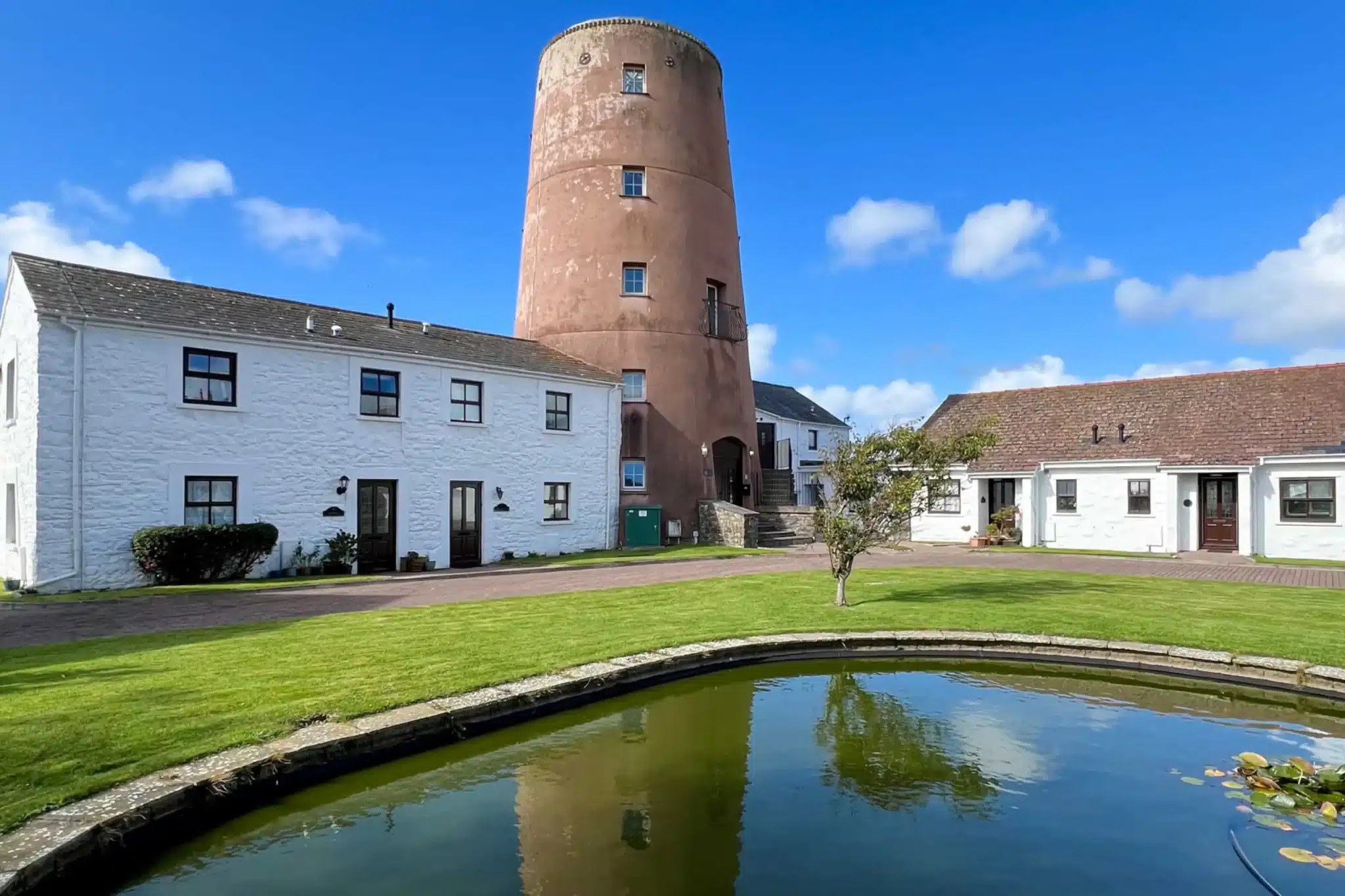
From the outside, it is a historic stone windmill tower dating from 1828. Step inside, however, and you discover something rather unexpected: curved walls, rooms arranged across different levels, a remarkable spiral staircase, a gallery suspended above the living space and a glass rooftop where you can watch the stars.
There is another story hidden within these walls, too. During the 1950s and 1960s, this site was home to the Museum of Magic and Witchcraft, closely associated with Gerald Gardner and the emergence of modern Wicca.
Today, the Witches Mill offers something increasingly sought after by travellers exploring unique holiday cottages: the chance to experience a building with a genuine past, rather than simply admire it from the outside.
And perhaps its greatest charm is how differently that experience unfolds for children, parents and grandparents sharing a holiday together.
A Windmill That Refuses to Be Ordinary
Most buildings are designed around straight lines. Rooms have corners, corridors connect familiar spaces, and you quickly understand the layout.
The Witches Mill is different.
Its circular stone walls dictate the shape of almost everything inside. Furniture sits against gentle curves. Rooms follow the tower’s unusual geometry. Instead of spreading across a conventional floor plan, the living spaces rise through the building.
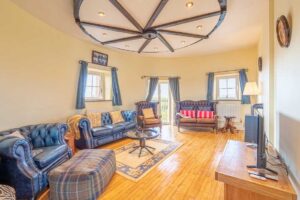
You find yourself looking upwards as much as around you.
This is one of the pleasures of staying somewhere with a distinctive architectural identity. The shape of the building is not merely decorative; it changes how you experience your surroundings.
The Witches Mill began life as a working windmill in 1828, part of the agricultural history of Castletown. Although the machinery and sails have long since disappeared, the substantial stone tower remains.
Its transformation into a four-storey place to stay has introduced contemporary comforts without disguising the building’s unusual character.
For anyone interested in historic places to stay, that balance is important. The attraction lies not in pretending that the past has been preserved unchanged, but in discovering how an old structure can acquire a new purpose while retaining its identity.
Exploring the Tower, One Level at a Time
Part of the enjoyment of arriving at the Witches Mill is discovering how its different spaces connect.
Ground Floor: A Welcoming Beginning
The ground floor contains two bedrooms, each with its own en-suite bathroom.
This arrangement is particularly helpful when several generations travel together. Grandparents, for example, may appreciate having their bedrooms and bathrooms on the entrance level rather than needing to climb the tower whenever they want to rest.
The bedrooms offer a comfortable starting point for exploring the building, while the unusual shape of the surrounding walls provides an immediate reminder that this is no conventional cottage.
The Mezzanine: Where Everyone Comes Together
A short climb brings you to the kitchen and dining area, arranged on a mezzanine level.
Here, the building becomes a place for the familiar rituals of family holidays: preparing breakfast, sharing stories over dinner and deciding what everyone would like to discover the following day.
It is an interesting contrast.
Outside the windows lies historic Castletown, while inside, everyday family life continues within the walls of a nineteenth-century windmill.
The kitchen is thoughtfully organised, with labelled storage and practical guidance to help guests find what they need. It is a small but important detail: unusual architecture should be enjoyable to experience, not difficult to live with.
The Living Room: A Reminder of the Windmill’s Working Past
Higher in the tower, the living room introduces another dimension.
The space is arranged around the circular structure, with balconies offering different perspectives over the surrounding landscape.
One of its most distinctive features is the original windmill hoist wheel, retained as a visible reminder of the building’s industrial past and incorporated into the room’s lighting feature.
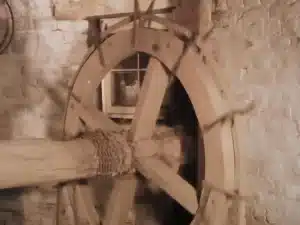
It is the sort of object that invites questions.
What was it used for? How did the windmill operate? What would this room have looked like when the tower was still part of a working agricultural landscape?
For children, it can become the beginning of a conversation about machinery and invention. For grandparents, it may evoke memories of older buildings and traditional ways of life.
And for everyone, it gives the room a sense of continuity between past and present.
The Spiral Staircase and the Gallery Above
Continue upwards and the architecture becomes even more adventurous.
A spiral staircase leads towards the uppermost gallery, where a steel-mesh floor creates an unusual relationship between the different levels of the tower.
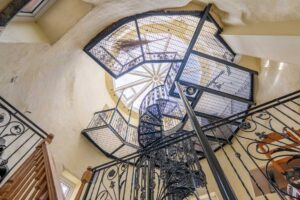
Looking through the mesh, you become aware of the building’s height and the spaces below. It is an experience that combines curiosity, a little excitement and a fresh appreciation of the tower’s vertical design.
This is not simply another room. It is somewhere to pause, look around and experience the architecture from an entirely different perspective.
The spiral staircase and meshed gallery are particularly memorable features, although they also require care.
Children under 12 must be accompanied by an adult on the upper levels, and guests should follow the safety guidance for using the gallery. Suitable footwear is important, and small or sharp objects should not be taken onto the mesh.
Families travelling with very young children, or anyone who finds stairs challenging, should consider the building’s layout before choosing their stay.
That is part of selecting unusual self-catering accommodation: understanding not only what makes a place extraordinary, but also how its distinctive features will suit everyone travelling together.
Beneath the Glass Rooftop: A Room Between Earth and Sky
At the top of the Witches Mill is perhaps its most unexpected feature.
The historic stone tower opens into a glass-roofed conservatory, creating a space filled with natural light and views across the southern Isle of Man.
After climbing through the enclosed, curved interior, the openness of this room comes as a surprise.
During the day, it is somewhere to sit quietly, enjoy the changing light and look across the surrounding landscape. The historic town of Castletown and the wider countryside provide a reminder of the island waiting to be explored.
But the experience changes after sunset.
As darkness falls, the glass rooftop becomes a window onto the night sky.
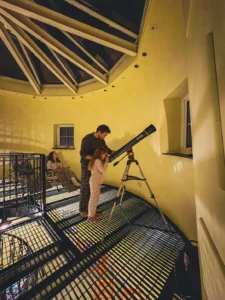
A telescope is provided for guests who would like to try stargazing. On a clear evening, families can gather beneath the glass, look for familiar constellations or take turns examining the Moon.
For children, the excitement may come from spotting something they have never seen through a telescope before.
For parents, it might be the pleasure of sharing that discovery.
And for grandparents, it can be an opportunity to tell stories about the night sky, childhood memories or the constellations they remember learning about.
Not every evening will be clear, of course. But even watching clouds move across the darkening sky can become part of the atmosphere.
It is easy to imagine this becoming one of those holiday moments that families remember long after returning home.
The Magical Tree: A Bedroom Made for Young Imaginations
Not every memorable feature of the Witches Mill comes from its nineteenth-century architecture.
One of its bedrooms contains a Magical Tree, created to bring a sense of storytelling and discovery into the experience of staying in the tower.
The tree incorporates lighting and a speaker system, with a dedicated phone used to control the effects and access selected audio experiences.
There is even a little tree-hole hideout, inviting children to create their own imaginary adventures.
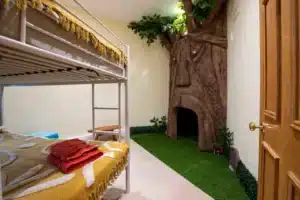
It is a room designed to encourage curiosity rather than simply provide somewhere to sleep.
Children might spend the day exploring a medieval castle, riding a heritage railway or learning about the island’s folklore, then return to a bedroom where stories and imagination continue.
The Isle of Man has a rich tradition of folklore, including tales of fairies, mysterious places and seasonal celebrations such as Hop tu Naa.
The Magical Tree brings a little of that storytelling spirit indoors.
For families travelling across generations, these smaller moments can be just as meaningful as the day’s major attractions. A bedtime story, a shared laugh or a child proudly showing a grandparent their favourite hiding place may become the memories everyone treasures most.
From Working Windmill to Museum of Magic and Witchcraft
The Witches Mill’s unusual architecture would be fascinating in its own right.
But its history gives the building an additional layer of meaning.
Cecil Williamson and the Museum’s Beginnings
In 1951, Cecil Williamson opened the Folklore Centre of Superstition and Witchcraft at the former windmill site in Castletown.
Williamson was a collector and researcher with a longstanding interest in folk magic, witchcraft and the beliefs associated with them.
His museum displayed objects and material connected with magical traditions and folklore, at a time when public attitudes towards witchcraft were undergoing significant change.
The museum later became known as the Museum of Magic and Witchcraft and is recognised as an important early institution devoted to the subject.
It is often described as Britain’s first Museum of Magic and Witchcraft, although its origins are more precisely understood through Williamson’s pioneering museum work and the establishment of the Castletown collection in 1951.
Gerald Gardner and the Emergence of Modern Wicca
Among the people associated with the museum was Gerald Gardner, one of the central figures in the development and public recognition of modern Wicca.
Gardner initially became involved with Williamson’s museum and was presented publicly as its resident witch.
Following their separation, Gardner took over the Castletown museum in the mid-1950s, developing his own collection and continuing to use the site as a centre for presenting witchcraft to the public.
His influential book Witchcraft Today, published in 1954, helped introduce his understanding of witchcraft to a much wider readership.
Gardner’s work and the religious tradition that developed around it became highly influential in modern Paganism, both in Britain and internationally.
The Isle of Man therefore occupies a distinctive place in this history.
It was not simply somewhere Gardner happened to live. The museum provided a public setting in which ideas, artefacts and accounts of witchcraft could reach visitors and readers at a formative period in Wicca’s development.
A History You Can Still Discover Inside
Today, visitors staying at the Witches Mill can encounter reminders of this remarkable chapter in its history.
Carefully arranged displays contain original objects, documents and publications associated with the former museum.
Among them are a set of blue teapot and sugar bowl bearing the Witches Mill name, used in the museum’s Witches Kitchen, and an original yellow metal road sign directing visitors towards the attraction.
There are also historic postcards showing the mill and people associated with it, a name card used by Monique Wilson, and a first edition of Gardner’s Witchcraft Today.
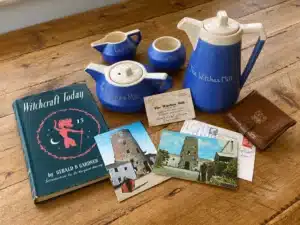
Wilson, who became an important figure in Gardnerian Wicca, was associated with the museum after Gardner’s death in 1964.
Historic photographs and paintings of the windmill, some more than a century old, provide further glimpses into the building’s changing appearance.
These collections are not presented as theatrical props. They are tangible connections with real people, events and a fascinating period in the history of modern religious movements.
For anyone interested in folklore, social history or the development of Wicca, they add considerable depth to the experience of staying here.
And for families, they offer opportunities for conversation: about what people believed, how attitudes have changed and why the stories of certain places continue to fascinate us.
Why a Historic Windmill Works for a Multi-Generational Holiday
One of the challenges of planning a holiday for several generations is finding somewhere that everyone can enjoy in their own way.
Children may be drawn to unusual spaces and opportunities for play. Parents often value somewhere comfortable to spend time together, while grandparents may appreciate history, atmosphere and the chance to share experiences with younger family members.
The Witches Mill brings these interests together within one building.
A child might be fascinated by the spiral staircase or the Magical Tree. A grandparent might spend time examining the historical photographs and museum artefacts. Parents might enjoy a quiet conversation beneath the glass rooftop after everyone has returned from a day exploring the island.
These experiences do not need to be scheduled.
They happen naturally because the building offers so many different things to notice, discuss and discover.
For birthdays, anniversaries or family reunions, that sense of shared discovery can be particularly meaningful.
There is something rather special about a place where three generations can spend the same afternoon together, yet each come away with a different favourite memory.
A Historic Town Just Beyond the Tower
The Witches Mill also has the advantage of being close to the centre of Castletown, the Isle of Man’s ancient capital.
A walk of approximately six minutes brings you into the historic town, where streets and buildings reflect centuries of Manx history.
At its heart stands Castle Rushen, one of the best-preserved medieval castles in the British Isles.
Families can explore its rooms, learn about its former inhabitants and discover how the fortress played a central role in the island’s history.
Castletown’s heritage railway station also provides an opportunity to experience the Isle of Man Steam Railway, whose traditional trains are part of the island’s distinctive transport heritage.
For a family holiday, this makes an appealing combination.
You can spend the day discovering castles, historic streets and railway journeys, then return to a place with an equally fascinating story of its own.
The Witches Mill is not simply a convenient base for exploring the Isle of Man. It becomes another chapter in the experience.
To plan your trip in Castletown and other historic towns on the Isle of Man, our free Isle of Man AI Trip Planner is a handy tool. You may also refer to our blog article “A Three-Night Isle of Man Cottage Break“.
What to Consider When Choosing Unique Holiday Cottages
Unusual buildings offer experiences that conventional accommodation cannot always provide. But their distinctive character also brings practical considerations.
A converted windmill, for example, is unlikely to have the same room proportions or straightforward layout as a modern purpose-built home.
At the Witches Mill, the curved walls, mezzanine levels, spiral staircase and gallery are fundamental parts of the experience. They are also features guests should understand before arriving.
The building has four bedrooms and accommodates up to eight guests, with two en-suite bedrooms on the ground floor.
Its different levels mean that stairs are part of daily life, and families should consider the mobility and supervision needs of everyone in their group.
There are also practical comforts that help make an unusual building enjoyable to stay in: a well-equipped kitchen, clear instructions for appliances, thoughtful organisation and a host who is available to answer questions.
These details matter because the best unique holiday stays combine character with genuine care for the people experiencing them.
For further guidance, read our article on how to choose self-catering accommodation on the Isle of Man, including the practical questions worth asking before booking.
A Different Kind of Holiday Memory
What makes a holiday memorable is not always the number of places visited or activities completed.
Sometimes it is the place where everyone gathers at the end of the day.
A curious child discovering a hidden corner. A grandparent sharing a story prompted by an old photograph. A family laughing over a game beneath the tower’s curved walls. Or several generations looking upwards together through a glass roof, hoping to catch a glimpse of the Moon.
These are the experiences that give unusual buildings their lasting appeal.
The Witches Mill is a historic windmill, a former museum associated with the beginnings of modern Wicca, and a carefully reimagined place for families to spend time together.
Its story has already unfolded across nearly two centuries.
Today, each family who stays there has the opportunity to add a few memories of their own.
If you would like to explore the building further, discover the photographs, layout and practical details of the Witches Mill in Castletown, and see whether this one-of-a-kind Windmill Tower might be the right setting for your next Isle of Man adventure.