
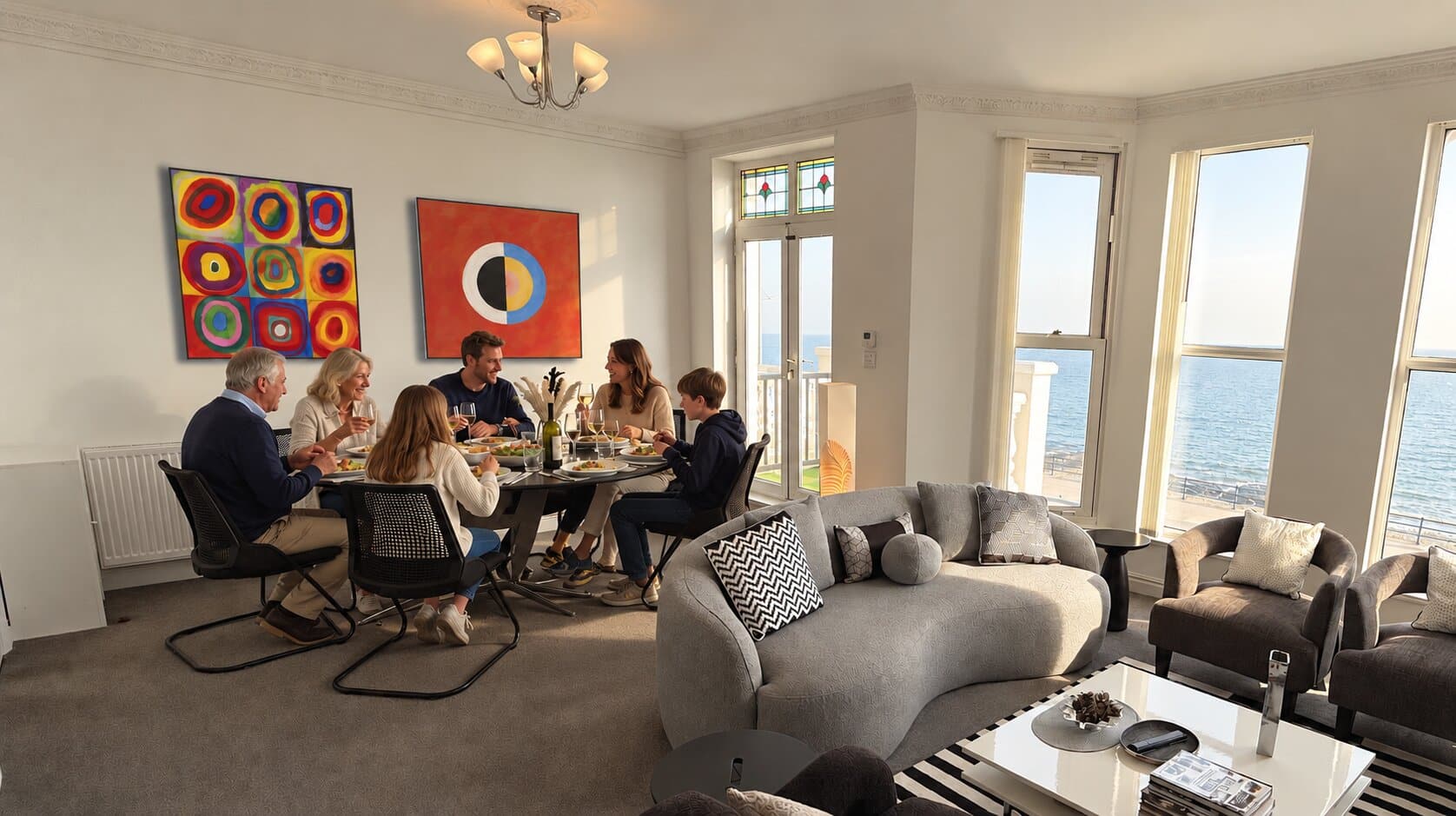
The freedom to eat breakfast when you want, give children their own bedroom, gather everyone around one table and come home at the end of the day to a space that feels like your own explains much of the appeal of self-catering. But choosing the right self catering Isle of Man accommodation takes a little more thought than simply filtering a search by dates, number of guests and price.
A property described as sleeping eight, for example, might have four double bedrooms — or two bedrooms, a sofa bed and several bunk beds. “Fully equipped kitchen” can mean very different things from one property to another. Free parking may be directly outside or several streets away. And a low nightly rate does not necessarily mean the lowest final booking price.
Having welcomed families and groups to our own Westminster Residence properties, we have seen which details make the greatest difference once guests actually arrive.
Here are the questions we think are worth asking before you book — whether you eventually stay with us or choose one of the many other Isle of Man self catering cottages and apartments around the Island.
1. Start With the People, Not the Property
Before opening an accommodation website, think about who is travelling.
A couple planning a walking holiday has very different requirements from a family of seven travelling with three children and two grandparents. Eight motorcycle enthusiasts visiting for the TT will have another set of priorities entirely.
Don’t just ask, “Does it sleep eight?”
Ask:
- Who will sleep in each bedroom?
- Does anyone need to avoid stairs?
- Do children need their own room?
- Will couples be comfortable sharing bathrooms?
- Does anyone need a bath rather than a shower?
- Will everyone want to eat together?
- Will you have one car, several vehicles or no car at all?
That simple exercise can eliminate properties that look attractive online but won’t work particularly well for your group.
This is especially important for multi-generational holidays. The best arrangement is not necessarily the property with the largest floor area; it is the one whose layout allows different generations to enjoy time together without giving up privacy and comfort.
2. Look Beyond the Number of Bedrooms
Four bedrooms do not necessarily mean the same thing in two different properties.
Check the actual bed configuration. Are the beds doubles, kings or singles? Can any large beds be divided into twins? Are advertised sleeping spaces permanent beds or sofa beds in communal rooms?
This becomes particularly important when adult friends are travelling together, or when grandparents, parents and children are sharing one property.
At our Tre property in Douglas, for example, two super-king beds can be configured as singles on request. It also has a separate upper-floor suite with its own bedroom, living area, kitchenette and en-suite shower room. That configuration can be useful for a multi-generational family because everyone remains under the same roof while one couple can have a little more independence.
The important lesson isn’t that one configuration is inherently better than another. It is to picture your actual travelling party occupying the rooms before you book.
3. Count Bathrooms Almost as Carefully as Bedrooms
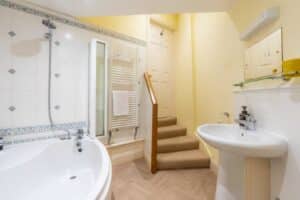
Bathrooms are easily overlooked during the excitement of choosing a holiday property.
For two people, one bathroom is usually straightforward. For seven or eight people trying to leave for a day’s sightseeing at the same time, bathroom arrangements can shape the morning.
Look beyond the headline number and find out:
- How many bathrooms have showers?
- Is there a bath if you need one for younger children?
- Which bedrooms are en-suite?
- Are any toilets separate from the main bathrooms?
- Are bathrooms located on the same floors as the relevant bedrooms?
For multi-generational groups, en-suite ground-floor bedrooms can be particularly useful because older family members do not have to negotiate stairs whenever they need the bathroom.
The Witches Mill in Castletown illustrates the point well. Its unusual vertical design is part of the experience, with curved walls, a glass rooftop, spiral staircase and meshed gallery high inside the historic Windmill Tower. But two en-suite bedrooms are situated at ground level, which can make the arrangement much more practical when several generations stay together.
A fascinating building and a sensible bedroom plan do not have to be mutually exclusive.
4. Ask What “Fully Equipped Kitchen” Actually Means

Self-catering officially means having your own property with full kitchen facilities, but that doesn’t tell you whether a particular kitchen will suit the way you cook.
If you intend to eat out most evenings, a fridge, kettle, toaster and somewhere to prepare breakfast might be all you need.
If you are bringing three children and grandparents for a week, the kitchen becomes much more important.
Look carefully at the photographs and amenity list. Depending on your plans, you might want to confirm the availability of:
- a full-size oven and hob;
- microwave;
- sufficiently large fridge and freezer;
- dishwasher;
- washing machine;
- pots and frying pans in useful sizes;
- sharp knives and chopping boards;
- baking trays;
- serving dishes;
- enough plates, glasses and cutlery for everyone;
- coffee-making facilities;
- children’s crockery, where relevant.
Think about the dining space too.
A property that sleeps eight but has a dining table for four may be perfectly adequate for a group that plans to eat out every night. It is less suitable for a family whose idea of a good holiday includes long breakfasts and evenings around the table.
At Westminster Residence, experience has taught us that small organisational details matter as well. Guests shouldn’t have to open every cupboard to find a wine glass or spend ten minutes working out where the recycling goes. Clearly organised and labelled storage can make an unfamiliar kitchen feel familiar surprisingly quickly.
5. Consider Where You Will Eat When You Don’t Want to Cook
Self-catering doesn’t mean self-cooking every day.
One of its great pleasures is having the choice.
Some evenings you may want to cook a family meal. On others, after exploring Castle Rushen, travelling on a heritage railway or walking one of the Island’s glens, nobody will want to prepare dinner.
Check what is within walking distance.
A beautiful countryside cottage may be exactly what you want, but understand that dinner could require driving or a taxi. If you prefer to leave the car behind in the evening, accommodation in Douglas, Castletown, Peel, Ramsey or another settlement with restaurants and pubs nearby may work better.
Our Belavista apartment, for example, is on Queen’s Promenade in Douglas with restaurants, bars and shops nearby. The Witches Mill offers a very different setting, yet Castletown centre, with its places to eat and drink, is about a six-minute walk away.
Neither location is universally “better”. The right choice depends on how you want your evenings to work.
6. Decide Whether You Really Need a Car
A car gives you considerable freedom on the Isle of Man, particularly if you want to explore more remote areas. But it isn’t essential for every holiday.
The Island has an extensive bus network, alongside its characterful heritage railways. If you plan to use public transport, don’t simply search for “near a bus stop”. Find out where that bus actually goes and how frequently the useful services operate.
This is particularly relevant when choosing between different areas.
Isle of Man Airport is served by Bus Vannin routes connecting it with Douglas and destinations in the south including Castletown, Port Erin and Port St Mary. If you’re flying and staying close to a useful route, a car-free visit can therefore be quite practical.
Before booking, check:
- distance to the nearest useful bus stop;
- services to the places you intend to visit;
- evening and Sunday timetables;
- walking distance from the stop with luggage;
- whether taxis are practical for occasional journeys.
And remember that public transport can be part of the holiday rather than simply a means of getting around. The Island’s heritage railways turn an ordinary journey into an experience that children, parents and grandparents can share.
7. If You Are Driving, Investigate the Parking Properly
“Parking available” is not quite enough information.
Does that mean a private driveway, reserved space, unrestricted street parking or a public car park nearby?
For families arriving on the ferry with luggage, the difference matters. It matters even more if your group is bringing several cars or motorcycles.
Ask yourself:
- Is the space guaranteed?
- How many vehicles will fit?
- Is there a height or size restriction?
- Is parking free?
- How far is it from the entrance?
- Can you unload luggage close to the property?
- Is EV charging available if you need it?
Tre, for example, has gated rear parking for one car or small van together with an EV charger. At Belavista, free street parking is available nearby, while private parking with lift access can be arranged on request.
Again, the useful information is not simply “parking: yes”. It is knowing exactly what the arrangement involves before you arrive.
8. Think About Your Arrival Before You Book
Your holiday doesn’t begin when you’ve unpacked. It begins when you step off the ferry or aircraft.
If you’re travelling by ferry with your own car, the onward journey is relatively straightforward: ferries arrive at Douglas Sea Terminal and you can continue directly to your accommodation.
If you’re travelling as a foot passenger, think about how you’ll manage your luggage between the terminal and the property.
The same applies when flying. Isle of Man Airport has both bus services and a taxi rank outside the terminal. Your choice of accommodation should therefore take account of how you intend to complete that final part of the journey.
This becomes particularly important for late arrivals, families with young children and larger groups requiring more than one normal taxi.
Ask the host for arrival advice before you travel. A host who knows the property well should be able to explain the simplest options.
9. Self Check-In Can Remove a Lot of Arrival Stress

Travel doesn’t always run to schedule.
Flights can be delayed. Ferries can arrive later than expected. Children need unplanned stops. Traffic happens.
Having to meet somebody at precisely 4pm to collect a key can add an unnecessary deadline to the journey.
Self check-in solves much of that problem, provided the instructions are clear.
Across Westminster Residence, we use smart locks rather than physical keys. Guests receive a time-sensitive access code and a short video guide approximately 48 hours before arrival.
That means there is no need to race to meet us at an agreed time. Guests can make their journey, arrive and let themselves in.
Technology, however, should make hospitality easier rather than replace it. We remain directly available by phone, email and WhatsApp before and during the stay.
When comparing accommodation, therefore, ask two separate questions:
Can I check myself in?
and
Can I reach a real person easily if something goes wrong?
Ideally, the answer to both is yes.
10. Good Instructions Are Part of Good Accommodation
There is little pleasure in spending the first evening of a holiday searching online for the manual for an unfamiliar oven.
The more facilities a property offers, the more important clear instructions become.
Heating controls, induction hobs, coffee machines, washing machines, smart televisions, EV chargers and sophisticated appliances may all be easy to operate — once you know how.

Good guest information should answer the obvious questions without making you contact the host every time.
At Westminster Residence, we have gradually expanded our guest information based on the questions people actually ask. That includes detailed pre-arrival information, practical house guidance, QR-code instructions and information about transport, restaurants and the Island.
It’s a small example of something worth looking for in reviews: not merely whether the property has plenty of equipment, but whether previous guests found it easy to use.
11. Read Reviews for Evidence, Not Just Scores
This is one useful lesson retained from our original Airbnb guide.
Ratings and platform badges can help narrow a search, but they shouldn’t make the decision for you.
Instead of looking only at the average score, read recent reviews and search for comments relevant to your priorities.
If you’re travelling with grandparents, look for comments about stairs, bathrooms and accessibility.
If you have young children, look for mentions of sleeping arrangements, safety and family facilities.
If you’re arriving without a car, search for comments about buses, shops and restaurants.
If you value peace and quiet, see what guests say about the surroundings.
And if you’re worried about cleanliness or host communication, look for repeated patterns rather than relying on a single enthusiastic or unhappy review.
Airbnb’s Guest Favourite or similar platform recognition can provide another signal, but it is still only one part of the evidence. The property itself — its layout, facilities, location and suitability for your group — matters more.
12. Check Who You Will Be Dealing With
There is an important difference between booking somewhere with a host who knows the property personally and communicating through several layers of customer service.
That does not mean one business model is always better. Large professional operators can have excellent systems and 24-hour support.
What matters is knowing what to expect.
Before booking, consider:
- Who answers questions before arrival?
- Is there a telephone number?
- Who can help if the heating stops working?
- Is support local?
- How quickly do reviews suggest problems are addressed?
- Can the host answer detailed questions about the property’s layout?
For Westminster Residence, guests communicate directly with us rather than a call centre. That is particularly helpful when somebody wants to know something very specific — whether a grandparent can use a particular bedroom, where an EV can be charged, or which bus to catch after arrival.
The best host communication is often the communication you barely notice: the information arrives before you need it, and help is available when you do.
13. Don’t Assume a Seven-Night Stay Is Required
Traditional holiday cottages were often associated with Saturday-to-Saturday bookings, but today’s Isle of Man holiday cottages and apartments can be considerably more flexible.
If you’re planning a long weekend or four-night break, check:
- minimum stay requirements;
- whether restrictions change by season;
- whether TT and Manx Grand Prix periods have different rules;
- available arrival days;
- whether shorter stays carry different pricing.
This is particularly important around major events, when accommodation demand and booking conditions can be very different from an ordinary week.
If the online calendar doesn’t accommodate your plans, it can be worth asking the host. Sometimes a short gap between existing bookings can suit both sides.
14. Compare the Final Price, Not the Headline Nightly Rate
This is one of the easiest mistakes to make when comparing Isle of Man accommodation.
A property advertised at £180 per night is not necessarily cheaper than one advertised at £200.
Depending on how and where you book, the final amount may include cleaning charges, platform service fees, taxes or other compulsory costs. Deposits and payment schedules can also differ.
Compare like with like.
Before making a decision, establish:
the total amount you will actually pay for the complete stay.
Then check:
- whether cleaning is included;
- whether there are mandatory additional charges;
- whether a security deposit is required;
- the payment schedule;
- the cancellation terms;
- whether booking directly and through a platform have different conditions.
For example, Westminster Residence’s direct website currently displays rates with fees and taxes included and does not require a security deposit. Guests pay 30% when confirming a booking, with the balance due 30 days before check-in.
Those terms won’t suit every traveller, nor will every operator use the same model. The important thing is transparency. You should understand the total cost and conditions before pressing “Book”.
15. Check That Your Accommodation Is Properly Registered
There is one Isle of Man-specific check worth making.
Visitor accommodation on the Island is subject to a formal registration system. Visit Isle of Man states that accommodation providers appearing on its official accommodation website have passed the applicable regulatory requirements and inspections.
The official self-catering directory is therefore a useful additional resource when researching a stay.
This is particularly helpful if you discover a property through a search engine, social media or a booking platform and want another source of information about registered visitor accommodation.
16. Choose Location Around the Holiday You Actually Want
It is tempting to ask, “Where is the best place to stay on the Isle of Man?”
There isn’t one answer.
Douglas can be particularly convenient for restaurants, shopping, entertainment and transport connections.
Castletown places you among some of the Island’s richest history, with Castle Rushen at its heart and the Steam Railway running through town.
Other visitors may prefer Peel, Ramsey, Port Erin or a rural setting precisely because they want something different.
Instead of asking which town is best, make a rough list of what your family wants to do and plot those places against potential accommodation.
Then think about your evenings as well as your days.
A family may happily drive across the Island to an attraction in the morning but value being able to walk to dinner at night. Grandparents might enjoy strolling through a historic town while younger family members want easy access to activities. A railway enthusiast might happily organise an entire day around the heritage transport network.
Location should support the rhythm of your holiday. Plan what your family wants to do is important before choosing your accommodation.
A Practical Self-Catering Isle of Man Checklist
Before booking, run through these questions:
- Does the bedroom configuration work for the actual people travelling?
- Are there enough bathrooms, and are they in useful locations?
- Can anyone with limited mobility reach the spaces they need?
- Does the kitchen contain the equipment you’ll genuinely use?
- Is there enough dining space for your whole group?
- Can you walk to somewhere for dinner?
- If you’re not driving, is useful public transport nearby?
- If you are driving, what exactly does the parking arrangement involve?
- How will you reach the property from the ferry terminal or airport?
- Can you check in independently if your journey is delayed?
- Are appliance and house instructions clear?
- Can you contact the host easily?
- Do recent reviews answer the questions that matter to your group?
- Are your required dates permitted under the minimum-stay rules?
- What is the final price, including compulsory charges?
- What are the payment and cancellation terms?
- Is the visitor accommodation properly registered?
If you can answer all of those before booking, you are far less likely to discover an unwelcome surprise after arrival.
Finding the Right Self-Catering Stay on the Isle of Man
There is a wonderfully varied selection of self-catering accommodation across the Isle of Man, from traditional cottages and town apartments to properties with histories and personalities all their own.
Choosing well is less about finding the property with the longest amenities list and more about understanding your own group.
A couple may value a view and somewhere good to eat within walking distance. A family with young children may care most about bedrooms, laundry facilities and a practical kitchen. A multi-generational family may need ground-floor bedrooms and several bathrooms, but also wants a living space where everyone can gather and make the memories that brought them to the Island in the first place.
That is where a little careful research pays off.
At Westminster Residence, our own collection includes the Victorian character of Tre in Douglas, the open views of Belavista on Queen’s Promenade and the one-of-a-kind Witches Mill in Castletown — an 1828 Windmill Tower later associated with Britain’s first Museum of Magic and Witchcraft, now a place where families can climb beneath its glass rooftop and stargaze together.
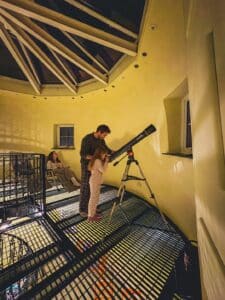
They are three very different properties, because there is no single formula for the perfect stay.
Whether you choose one of ours or discover another great find elsewhere on this magical Island, ask the practical questions first.
Then, when you arrive, everything else becomes much simpler: settle in, explore the Isle of Man and enjoy being together.